
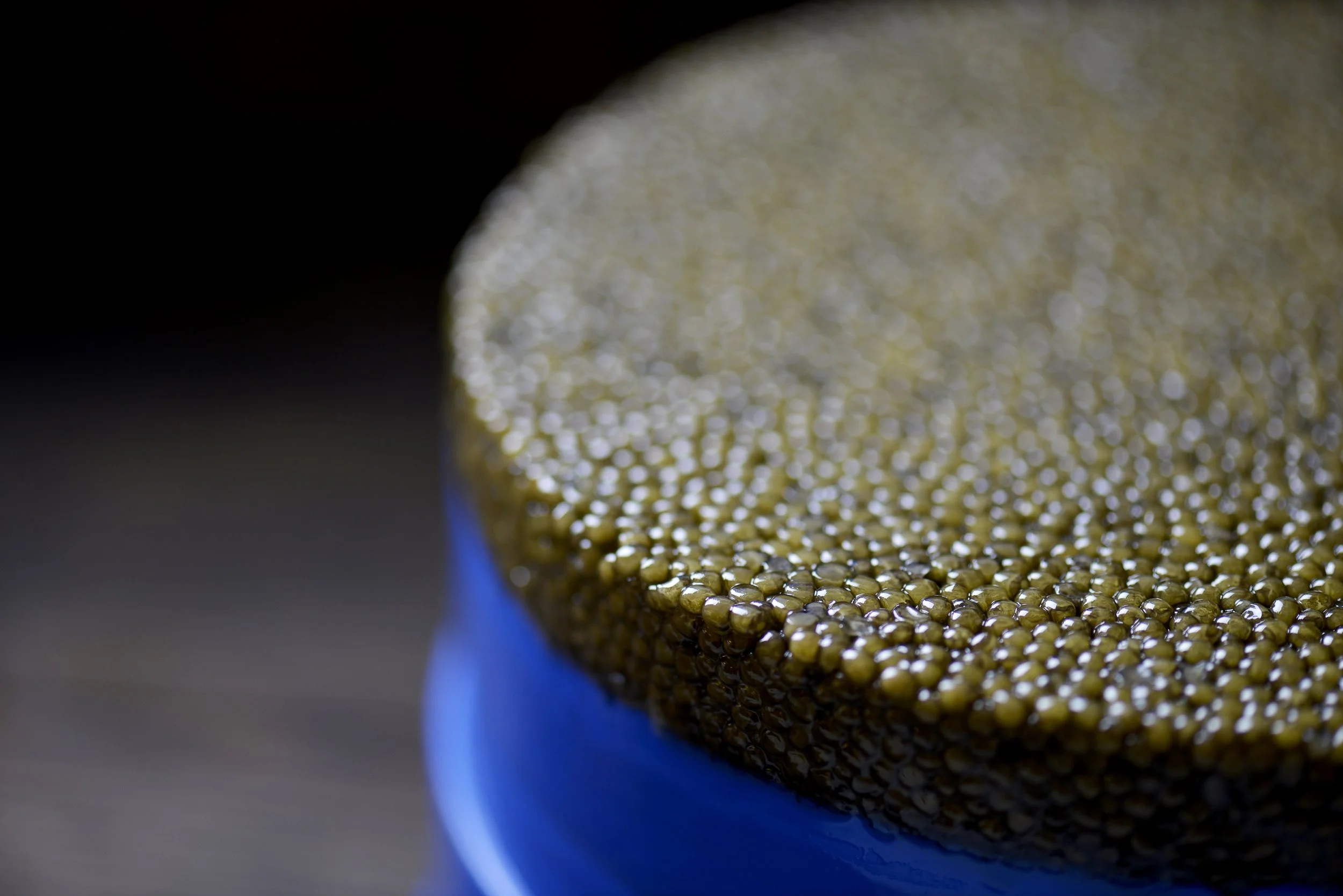
CAVIAR LONGINO & CARDENAL
It was the favorite food of the Shahs of Persia and the most sought-after dish at the tables of the Tsars of Russia. Now, it is perhaps the most precious food available on the market: ladies and gentlemen, His Majesty Caviar. Its distribution in Italy is closely linked to our history. At Longino & Cardenal, we started our business by importing fresh caviar from Iran, which we repackaged in a small warehouse on the outskirts of La Spezia. That was back in 1988, and we were the first to obtain authorization to do so. Since then, we have proudly continued to distribute it to the best restaurants and most sought-after delicatessens in our country. And that's not all.
His Majesty Caviar, the food of the tsars
Hard to believe we’re “just” talking about eggs. Yet even when you strip it down to the bare minimum, caviar never loses its reputation as the ultimate delicacy, synonymous with luxury and exclusivity. At the end of the day, it is nothing more than sturgeon roe – a very ancient fish that dates all the way back to prehistoric times. A fish without a central bone structure, protected instead by an outer armour of bony plates.
In the wild, truly wild caviar – now almost completely extinct – is born and grows in the freshwater basins that flow into the Caspian Sea.
In our collective imagination, its fame has always been intertwined with the exotic, mysterious tales of the shahs of Persia and the opulent luxury of the Russian tsars’ court. Originally a food reserved solely for nobility and rulers, it has nonetheless managed to preserve its aura of extreme preciousness and refinement.
A status symbol and iconic product par excellence, it represents the image of Iran around the world. It is so symbolic that, when the last Shah of Persia fell, sturgeon fishing was entrusted to a dedicated Iranian state body, Shilat, which brought all production under its control.
We at Longino & Cardenal are deeply connected to the story of caviar, because our business began precisely with the import of fresh caviar from Iran.

The story of caviar in Italy
It was 1988 when four friends – the original founding partners of Longino & Cardenal – decided to start importing fresh caviar into Italy from what was once Persia, repacking it in a small warehouse on the outskirts of La Spezia. To do so, they obtained licence “number 1” – IT0001 – as the first Caviar Repackaging Facility in the country. In a short time, we established ourselves as a company specialising in the distribution of caviar to top restaurants and the finest gourmet food shops throughout Italy.
In those years, the 1.7 kg tins of sturgeon roe arrived in La Spezia directly from Iran, sealed with their typical elastic bands, each colour indicating a different type of caviar: Sevruga – the smallest eggs – with a red band; Asetra – the most common, medium-sized eggs – with a yellow band; and finally Beluga – the king of caviar, with its very large eggs – with a blue band.
The tins were always bundled three by three in special protective stockings and packed four stockings at a time into distinctive lead-sealed wooden crates: a real treasure chest made up of 12 caskets containing the very pinnacle of gourmet excellence.
By 1992, we were selling almost 1,000 kilograms of caviar a year. Those were the days when Sevruga caviar, then the most widespread, was sold at 500,000 lire per kilo. The global market exceeded 300 tonnes a year, and no one was yet talking about the risk of sturgeon extinction or the need to regulate fishing.

The excellence of our farmed caviar
When all Acipenseriformes – sturgeons and paddlefish – were added to the list of protected species by CITES, the international body that safeguards endangered species, and a total ban was subsequently imposed on fishing in the Caspian Sea, the sale and therefore the consumption of wild caviar were effectively prohibited.
Fully aware for many years of what was coming, and determined to guarantee continuity for our customers, we had already begun to complement Iranian caviar with a high-quality product obtained from farmed sturgeon raised in the pristine waters of Qiandao Lake, in the province of Zhejiang.
Here, different sturgeon species are fed naturally in flowing-water ponds. The fish are kept in floating nets and fed regularly until they are 2–3 years old. They are then sorted by sex and separated according to age, species and size. Depending on the species, after another 6–8 years the sturgeon will be ready either to produce caviar or to fertilise the eggs. Because they are moved into artificial tanks only at the very end of the maturation period, the fish never develop any muddy off-flavours.
At first glance, caviar production may seem simple, but it actually demands great skill and expertise. It is essential to identify the exact moment at which to harvest the sturgeon – it must be before it lays its eggs. At that point, the ovarian sacs are removed and placed in mesh sieves, then gently massaged so that they release the eggs. These are rinsed, mixed with salt and finally vacuum-packed.
The amount of salt added determines the final saltiness of the product, but the speed of processing and the ambient temperature also play a key role in defining its organoleptic qualities. The secret of truly outstanding caviar lies in the details. You need to know precisely when the sturgeon is “ready” to be harvested: if the egg is too advanced in its maturation, it will be soft and oily; if it is not mature enough, it will be hard and lacking in flavour.
Traditionally, the Iranians harvest the fish slightly earlier than the Russians: Iranian caviar therefore has firmer, more distinct eggs, while Russian caviar tends to be richer and more unctuous. And then there is the question of technique: every single stage of processing requires extraordinary delicacy.
We received definitive proof of the excellence of our caviar masters, who raise the sturgeon and prepare the roe, in 2008, when we invited some of the greatest experts and served them a blind tasting that mixed wild caviar with our farmed caviar. Not one of them was able to tell the difference.

Caviar: all the varieties
Colour, firmness, size and regularity of the eggs, aroma, sheen, flavour and integrity: these are the characteristics that allow us to classify caviar by quality and define its different types.
As the very first product ever sold by Longino & Cardenal, caviar naturally holds a place of honour in our catalogue. You’ll find four main types, each with its own story to tell and a unique flavour to discover.
But remember: whichever variety you prefer, to appreciate it fully it must be enjoyed well chilled, on its own, in purity. It’s a product that should never be missing on special occasions – and it’s the perfect gift. Especially at Christmas.
Beluga Caviar
Beluga is the undisputed king of all caviars and comes from the precious roe of Huso huso, one of the largest sturgeon species. These fish reach maturity between 15 and 20 years of age, but can live up to 100 years and exceed 1,000 kg in weight.
Its colour ranges from pearly to metallic grey. The eggs, with their extraordinary sheen, are smooth and uniform, with a diameter of more than 3.5 mm and a very thin membrane. It is prized for its full-bodied, creamy flavour with a long, lingering finish.
Karaburun Caviar
Karaburun is a special selection of Asetra caviar. Only the lightest, golden-coloured eggs are chosen. The female Acipenser gueldenstaedtii matures in about 8–9 years and reaches a weight of around 15–20 kg, producing between 10 and 15% of its weight in caviar.
The unexpected golden hue, combined with its extraordinary shine, makes this caviar resemble a precious jewel box, with a delicate hazelnut note on the palate.
Asetra Caviar
Asetra comes from Acipenser gueldenstaedtii, a sturgeon species that has populated the Russian side of the Caspian Sea for centuries. A female matures in about 8–9 years and reaches around 15–20 kg, producing between 10 and 15% of its weight in caviar.
The eggs have a diameter of about 2.9 mm. Their colour varies from dark grey to pearly, and Asetra is much appreciated for its delicate hazelnut flavour.
Kaluga Amur Caviar
Kaluga Amur, a favourite with chefs, is obtained from a hybrid sturgeon: a cross between a female Huso dauricus and a male Acipenser schrenckii. This species matures between 8 and 10 years of age and can live up to 60 years, reaching more than 50 kg in weight.
The eggs are large and firm, with a diameter of over 3 mm. Their characteristic light greenish shades herald a creamy taste with a long persistence on the palate.
Baikal Caviar
Baikal Caviar comes from Acipenser baerii, better known as Siberian sturgeon. This species usually matures in 7–8 years and can live up to 20 years, reaching 15 kg in weight.
The eggs, with a diameter of about 2.8 mm, are dark in colour, tending towards black. The flavour is pronounced, with a gentle aftertaste that makes it ideal for pairing with other ingredients.
Pure Caviar
Pure Caviar is obtained from the same sturgeon species as Asetra. What makes this variety special – also known as “pure salt” – is the complete absence of additives and preservatives. The only ingredient added to the “pure” sturgeon eggs is salt.
Its flavour differs significantly from traditional caviar, as it preserves the original, unaltered saline taste. It is a product that can be especially appreciated by purists and by the strongest advocates of green, clean food.