

PETUNA
Petuna is the first aquaculture company in the world to have obtained “Best Aquaculture Practices” (BAP) certification for both Atlantic salmon and ocean rainbow trout, the famous Wagyu of the sea. A family business founded by Peter and Una Rockliff in 1949, in over 70 years of activity, it has become Tasmania's leading player in the sector, specializing in the marketing of wild and farmed fish products. Environmental and social responsibility are core values for Petuna, as are community relations, employee safety, food safety, animal health, and wildlife care.
Petuna, a family story
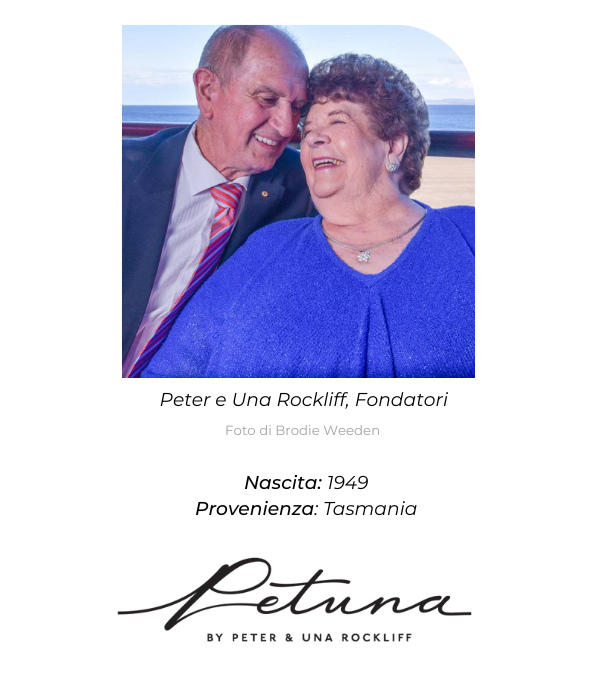
The story of Petuna began over 70 years ago, born from the passion of two people rather than from industrial demand. It was 1949 when Peter Rockliff – a young professional fisherman – met Una, his future wife, on the docks of Bridport. Together they decided to embark on an adventure that would shape both their family life and their business for decades to come.
At the beginning, Peter spent his days out on the ocean, while Una sold the day’s catch directly from the boat and then from a small shop in Devonport. As the years went by and the business evolved, husband and wife chose to diversify, and in 1990 they moved into aquaculture, becoming pioneers of Tasmanian Ocean Trout.
Petuna is a family enterprise that has made continuous innovation and a strong commitment to environmental sustainability and social responsibility – such as supporting the local community, protecting employees, ensuring food safety, safeguarding animal welfare and caring for wildlife – its non-negotiable guiding principles.
It is precisely these values that led Petuna, in 2018, to become the first aquaculture company in the world to obtain BAP (Best Aquaculture Practices) certification – one of the most important international standards – for both Atlantic salmon and ocean-raised rainbow trout.
How did the Tasmanian rainbow trout come about?
Petuna Ocean Trout comes from the remote south-west coast of Tasmania. It is here, in Macquarie Harbour – a vast inlet of more than 300 square kilometres and a UNESCO World Heritage site – that the cool waters of the Franklin and Gordon rivers meet and clash with the salt water of the Great Southern Ocean. This brackish mix of fresh and salt water creates the ideal natural environment in which ocean trout can thrive and grow. This is the natural habitat where the purest ocean trout is born.
Petuna’s process for raising ocean trout begins with the selection of the very best eggs, which are fertilised at the Cressy facility in inland Tasmania. The young trout remain here for around 12–18 months, until they reach a weight of about 120 grams. Only then are they transported more than 300 km away, to suspended sea pens in the middle of Macquarie Harbour. These are large enclosures of more than 20,000 cubic metres, where the fish – the compact school occupying only 5% of the available space – can swim freely, immersed in the marine habitat best suited to their growth.
They stay there for a further 13–20 months, until they reach 3.5–5 kilograms in weight. The brackish waters of Macquarie Harbour’s natural inlet protect the trout from AGD (Amoebic Gill Disease), a potential illness that particularly affects salmon and trout. It is caused by Neoparamoeba perurans, one of the most dangerous organisms for aquaculture, which, however, is unable to develop in these waters. In addition, there are no seals here – which are very active in other parts of the island and would obviously be a threat and a source of stress for the fish.

The crystal-clear waters, a diet that follows what the fish would naturally eat (plant-based feeds and fish, oils, vitamins and minerals), the total absence of antiparasitics, antibiotics or GMOs, and the chance to absorb the natural mineral salts carried by the Franklin and Gordon rivers – these are the factors that make Tasmanian Ocean Trout a true gastronomic excellence.
The fish are harvested using pipes that draw in the water. The trout do not resist, because they are naturally used to swimming against the current. From there, they move into holding tanks where they are channelled along without suffering or stress – and therefore without releasing lactic acid into the flesh. They are then taken to the processing plant in Devonport and processed within 6 hours of harvest, so that their freshness remains completely intact.
We at Longino & Cardenal decided to include Tasmanian Ocean Trout in our catalogue because we wanted a “healthy” product of the highest quality, with flavour and texture that are truly rare and precious – an outstanding alternative to salmon for fine dining. Its flesh is a bright pink colour, with a remarkable marbling of fat between the flakes. Our suggestion for enjoying it at its best is to serve it raw, although it also remains very moist and juicy when cooked.
A curiosity? Tasmanian trout prepared by chef Tetsuya Wakuda is said to be the most photographed dish in the world!
Not only Ocean Trout: Petuna exclusivity also means Atlantic Salmon
Alongside ocean trout, Petuna also farms Atlantic salmon, and the farming practices follow the same values of ethics, environmental respect and animal welfare adopted for ocean trout. As with Tasmanian trout, everything starts with the selection of the best eggs, which are once again fertilised at the Cressy facility. The young salmon stay there until they reach the right size and weight to be moved to open water.
Their dedicated sea site is Rowella, located at the mouth of the Tamar River in northern Tasmania: this is the perfect habitat for them, because the river drives strong tidal movement, ensuring a constant exchange of water and lower salinity during the summer. Rowella is also less susceptible to AGD and is equipped with a technological seal-deterrent system that reduces stress on the fish and contributes to better growth and more delicate flesh.
Generous space to swim, natural feed, and the total absence of additives, drugs and colourants make Petuna Atlantic salmon a delicate shade of pink – less intense than that of ocean trout – with moderate fat marbling and a cleaner, more refined flavour and texture than most salmon commonly found on the market.
It is a very healthy fish, naturally rich in omega-3, and lends itself to a wide variety of recipes: thanks to its versatility it can be grilled, baked, smoked or served raw as sashimi. Perfect for every convivial occasion.
