
FUENTES
Bluefin tuna is a special fish, the most noble of all the varieties that exist. It is no coincidence that when we talk about “tuna” without specifying the species, we mean bluefin tuna. It is the tuna par excellence. And with good reason. In fact, there are many reasons: where it is born, where it migrates to reproduce, what it eats, even how it is caught and how its meat is treated. Its entire life tells a story of excellence. But only a few know how to write chapters, paragraphs, and anecdotes about it, and the best storyteller of all is Fuentes. Because Fuentes doesn't just fish for bluefin tuna. He breeds them!
Global leadership
The founder, Ricardo Fuentes, believed in this market before anyone else: a pioneer in Europe in the farming and marketing of bluefin tuna, he has 50 years of experience in the sector.
Fuentes is now the world leader in bluefin tuna production and exports around 85% of its production, thanks to farms located in Spain, Malta, Tunisia, Morocco, Italy, and Portugal.
Fuentes makes sustainability its strong point: uncompromising quality, ensuring absolute excellence for the end customer. After their natural migration, wild tuna are moved to Fuentes' farms.
Here they are farmed in the open sea, fed in a completely natural way, and caught only at the direct request of customers. This method of fishing means that every part of the bluefin tuna can be consumed, fresh in every season of the year.
All bluefin tuna are wild adult specimens, caught using sustainable fishing techniques. They are farmed, fed, and harvested on demand, following the Japanese ikejime technique, which prevents the tuna from releasing lactic acid and ensures optimal meat quality. This ancient technique neutralizes the fish's nervous system, preventing stress and pain.
For more than 30 years, Fuentes Bluefin Tuna has been the favorite of the most demanding market: Japan.

Fuentes Bluefin Tuna, Prince of the Mediterranean Sea
The life of bluefin tuna begins in the freezing waters of the northern seas. It is an Atlantic fish, but it chooses to migrate to warmer, calmer waters such as those of the Mediterranean to lay its eggs. It has been doing so since the dawn of time, so much so that the history of the Mare Nostrum is dotted with its exploits. All the peoples who have inhabited its shores, from Italy—where fishing for tuna has always been an important tradition—to Greece, passing through Tunisia—it even seems that the name of this country derives from the word “tonno” (tuna)—have fed on it and learned how to prepare its meat.
This fish, which can weigh up to 600 kg, has for centuries been the perfect solution for the survival of millions of people. Only recently has it gone from being a staple food to a highly sought-after gourmet product. This is thanks to Japanese cuisine, which has been able to ennoble its meat, managing to enhance the full spectrum of flavors and textures it offers.
The history of Fuentes' expertise begins right here in Spain, where bluefin tuna has become a culinary delicacy. A delicacy that speaks of environmental sustainability, respect for species conservation rules and fishing processes, and unconditional product perfection. All certified at every stage by ICCAT – the International Commission for the Conservation of Atlantic Tunas.
With their fishing boats, Fuentes manages to catch all the tuna needed for an entire year's production within a maximum of 15 days using a ‘circling’ technique. It identifies the fish gathered in schools, ‘encircles’ them with a net and, once caught, slowly drags them (at about 1 km per hour) to the place where they will be farmed to regain the strength and weight lost during their long migration journey. But not all of them will make it there: only those allowed by the catch quota and size parameters established by ICCAT will reach their destination, while all the others will be released.
Here, they will be fed only sardines and mackerel, they will fatten up and their flesh will regain its ideal weight and consistency. Only then can they be caught to order for the customer. Unlike other purse seine fishermen, Fuentes has chosen not to use Japanese factory ships that completely empty the nets and take away all the fish. This ethical choice is in line with sustainability—even the final moment of tuna capture is supervised by ICCAT officials—and uncompromising quality, so as to guarantee absolute excellence for the end customer. In practice, this means fish that can be processed and consumed in its entirety at any time of the year, fresh in every season.

All cuts of bluefin tuna
The flesh of bluefin tuna varies depending on its distance from the skin. On the outside, there is a layer of fat that protects the fish from cold temperatures. This is not the case with tropical tuna, which has completely uniform flesh. Bluefin tuna is fatty on the outside and lean on the inside. This characteristic allows for multiple cuts and uses, so much so that the Japanese have given each of these parts its own name, such as Akami Maguro for the fillet or Otoro for the belly.
From tartare to sashimi, from appetizers to main courses, from raw to cooked, from fillet to belly, from cheeks prepared like braised meat to grilled steak: nothing is wasted when it comes to tuna.
Every part, every cut lends itself to the creative interpretation of chefs around the world, giving those who eat it a surprising taste and texture experience every time. At Longino & Cardenal, we have the exclusive Fuentes brand in Italy. Each tuna arrives with a series of certifications attesting to its quality and is equipped with a QR Code that guarantees its traceability: where it was caught and on which boat, how much it weighed at the time of capture, what it ate. This label is delivered to the restaurateur, who can then show it to the customer as confirmation of the absolute excellence of what is on the plate. After all, what is good and beautiful must also be able to tell a story of beauty and goodness.

From catch to plate, the journey of Fuentes Bluefin Tuna in the name of sustainability
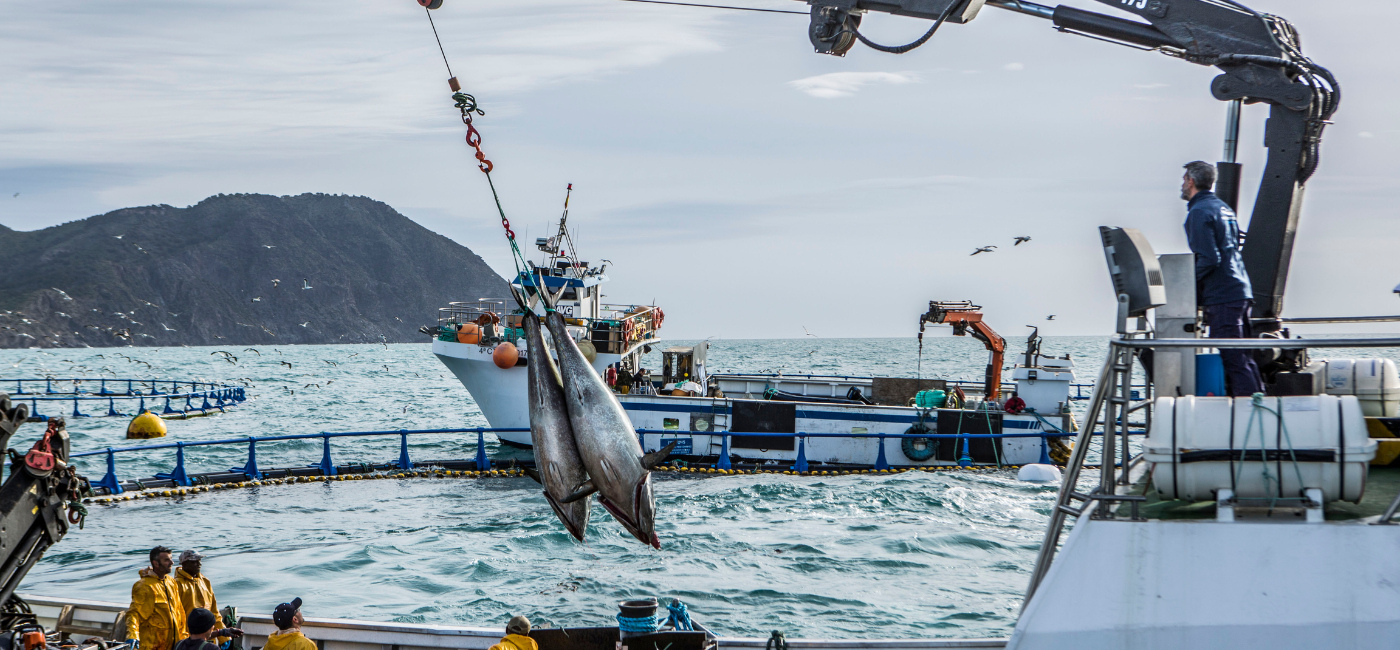
Once a year, towards the end of the bluefin tuna migration from the cold waters of the North Atlantic to the warmer currents of the Mediterranean, Fuentes fishing boats cast off and set out in search of them. Once the school of tuna has been located, a small boat is lowered from the vessels and drags the end of a net around the school. Once completely surrounded, the net is closed and the fish are caught without stress. This technique is known as purse seining. In this net tank, the fish are dragged at a speed of two miles per hour to the Fuentes facilities. Here, by sewing and unsewing the traveling net, the tuna are transferred to stationary nets where they will begin the farming phase.
Inspectors from the ICCAT (International Commission for the Conservation of Atlantic Tunas) monitor all stages of fishing to verify that catch quotas and pre-established size parameters are respected: tuna that are too small, which would pose a risk to the conservation of the species, are released.
Furthermore, once the permitted quota has been reached – which is verified by underwater cameras – fishing is stopped and the excess tuna are released.
Bluefin tuna: from fishing to farming
Why catch fish and then farm them?
Because when tuna come to spawn, much of their energy and effort is focused on reproduction, and they are subjected to severe stress. In addition, the animals choose to lay their eggs in places where there are no fish that can eat them. But these fish are also the food that bluefin tuna feed on, so the animals have nothing to eat.
Inside Fuentes' stationary nets, bluefin tuna are fed sardines and mackerel (what they would eat in the wild) and have the opportunity and time to return to optimal health. They fatten up and regain the weight they lost swimming from the Atlantic to the Mediterranean.
Unlike all other purse seine tuna fishermen, Fuentes does not call in a Japanese factory ship to empty the net completely and process all the fish at once. He keeps it alive all year round and only fishes it on customer request, even managing to identify the desired size and weight.
The tuna is cleaned, gutted, and placed on ice in just four minutes. This is done without causing any stress, which would cause lactic acid to be released into the muscles and compromise the texture of the meat, making it opaque. By doing so, even when raw, it will be very shiny.
But the precautions for unconditional quality do not stop there. As soon as it is caught, the fish is cored with a straw to check the quality of the meat. Two samples—one from the back and one from the tail—are immediately sent by motorboat to be subjected to specific analyses on land. In this way, the clarity and percentage of fat in the meat are verified. If it is not first choice, the fish is downgraded.