

MADAMA BIANCA
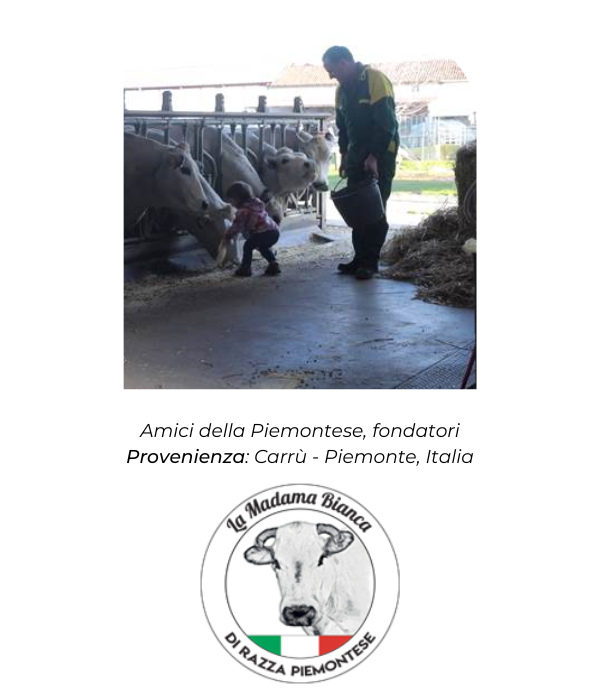
2018 Carrù, Piedmont. A group of farmers, guided by the same values of quality and respect for animals and the environment, decide to join forces to create Madama Bianca Amici della Piemontese, an association dedicated to promoting the Piemontese, a native cattle breed and the only “gourmet” breed in Italy. The Piemontese cow, and in particular the Madama Bianca (a special selection of the best Fassone cows), is characterized by its white coat and the fact that it is bred almost exclusively in Piedmont. Its fame is closely linked to its unique characteristics: from muscular hypertrophy, which allows for a high yield at slaughter, to the composition of its fat, rich in omega-3 unsaturated fatty acids, which make its meat delicious, exceptionally healthy, and tasty.
Her Ladyship, Madama Bianca Piemontese
On 14 February 2018, a group of 29 Piedmontese cattle breeders – all small family-run farms – met before a notary to sign the founding act of “Gli Amici della Piemontese”, an association created with the aim of enhancing Piedmontese Fassona beef and guaranteeing the end consumer a product of incomparable quality and flavour, while at the same time respecting both the animals and the environment.
Within the association, a series of labels were introduced to identify the different types of animals belonging to this breed. Among them is “Madama Bianca”, which represents the top selection of the very best Fassona: adult females over 48 months of age, raised on the same farm where they were born and fed in an extremely clean way, with top-quality, natural, plant-based feed.
The date chosen for the creation of the consortium is anything but random: Valentine’s Day was selected by the founders not only as a good omen, but also to underline the devotion and commitment that each of them has always poured into this work. A love story, then, that of “Gli Amici della Piemontese”, which led them to double the number of members by the end of the same year and to exceed 100 members within just 24 months.
And to think that what makes Piedmontese Fassona in general – and Madama Bianca in particular – such a gourmet delicacy is, strictly speaking, a defect: muscular hypertrophy of the thigh, to use the scientific term. For food lovers, however, this extreme muscle development is the key to meat that is elegant, refined and, above all, incredibly tasty.
A true gourmand’s meat, also ideal for athletes and people on a diet. Extremely lean and healthy, with low cholesterol and little connective tissue, and an incredible ratio of saturated to unsaturated fatty acids: 1 to 3 in favour of the latter. A meat whose nutritional virtues are very similar to those of fish, thanks to its high content of omega-3 and omega-6.
Not only that: Madama Bianca is a perfect meat for the restaurant industry because, besides being delicious, it has excellent yield on the plate and is suitable for every type of preparation – from raw (who could forget classic hand-chopped tartare?) to cooked, whether with short or long cooking times.
Fassona lends itself to all kinds of cuts. Of course, restaurants tend to use those that are simpler, quicker and easier to work with – like hand-chopped tartare, already prepared and portioned, or sliced cuts such as Florentine steaks and ribs, vacuum-packed and ready to cook. Not to mention the vast world of gourmet burgers, made by blending different cuts, including from the forequarter, to make the meat even more flavourful.
But respect for the environment also means making full use of the whole animal, and not just its most noble cuts.
To achieve this, you need skilled, artisanal butchers who know how to bring out the best in the so-called secondary cuts, such as skirt, offal, cheek and tripe. Otherwise, it would mean wasting all the sustainability work that goes into raising the animals properly and cleanly. All members of “Gli Amici della Piemontese” have in fact decided to adopt traditional farming methods, with no more than 100 animals in their barns. Only intensive farming can guarantee a constant supply of certain “exclusive” cuts, but this has a devastating impact on the environment, both in terms of resource consumption and food waste.
The association has therefore committed to a promotional and educational campaign aimed at rediscovering these lesser-known cuts. An ethical choice that also opens the door to flavours and textures that are “rare and precious”, and would otherwise be lost. A philosophy of respect, research and unique expertise that we at Longino simply had to embrace.

At the heart of the excellence and delicacy of Madama Bianca Fassona beef lies the shared commitment of all the breeders belonging to Gli Amici della Piemontese to adopt farming methods focused on full animal welfare and environmental sustainability.
The decision to include among the members only small, family-run farms with a limited number of animals – between 80 and 100 head – is the condicio sine qua non for guaranteeing this goal.
The animals mainly eat cereals and hay, often grown in the fields and meadows surrounding the farmhouse owned by the member farm. A small amount of maize concentrates is added during the fattening phase and is given together with dried grass. It is this natural mix that gives the meat its distinctive flavour of cereals and hay.
The cows are always kept in small groups of 4–5 animals and have plenty of space to move, both in the barn and outdoors: Piedmontese Fassona are delicate animals and the more they live in free, airy and clean environments, the less likely they are to fall ill. As a result, the use of antibiotics and medicines is substantially reduced.
In addition, 80% of the association’s breeders move their animals to mountain pastures in summer: in this way, they not only preserve the animals’ wellbeing, but also help to maintain the mountains, keeping them clean and restoring the paths.
From the point of view of environmental protection, understood as limiting pollution, it is also worth highlighting that the manure of these animals is very dry and barely “contaminated” by chemical agents, and does not need to be disposed of – quite the opposite. It is in great demand for fertilising fields, particularly vineyards and hazelnut groves. Many of the local wineries are biodynamic and organic: since Fassona manure does not contain residues of antibiotics, it does not contaminate the terroir. In other words, what might be considered “waste” is not a problem but an added value.
But the most important factor for the welfare of the cow is that the calf is never separated from its mother.
